What Is a Tummy Tuck and Am I a Good Candidate?
Written by Mr Kuen Yeow Chin, Consultant Plastic Surgeon, London and Berkshire
A flat, well-toned abdomen is something many people work hard to achieve through diet and exercise. But for some, no amount of effort produces the result they are looking for. Loose skin following pregnancy, significant weight loss, or simply the natural ageing process can create changes to the abdomen that exercise alone cannot address. This is where abdominoplasty, commonly known as a tummy tuck, becomes relevant.
This guide explains what a tummy tuck involves, who is most likely to benefit from it, and what recovery looks like. If you would like to discuss whether tummy tuck surgery is right for you, Mr Kuen Yeow Chin offers consultations in London, Berkshire, and Surrey.
What Is a Tummy Tuck?
A tummy tuck, or abdominoplasty, is a surgical procedure that removes excess skin and fat from the lower abdomen and tightens the underlying abdominal muscles. The result is a flatter, firmer abdominal contour that is better proportioned to the rest of the body.
It is important to understand that a tummy tuck is not a weight loss procedure. It is a body contouring procedure designed to address structural changes to the abdomen that cannot be resolved through non-surgical means. The ideal candidate is someone who is already at or close to their target weight but is frustrated by loose skin or muscle separation that persists despite a healthy lifestyle.
The procedure is one of the most consistently performed in plastic surgery, particularly among women following pregnancy and individuals who have achieved significant weight loss. Men also undergo tummy tuck surgery, often in combination with liposuction, to address excess skin and fat around the abdominal area.

What Types of Tummy Tuck Are Available?
Full abdominoplasty
A full tummy tuck addresses the entire abdomen from the rib cage to the pubic area. An incision is made horizontally, typically low enough to be hidden by underwear or swimwear, and a second incision is made around the navel to allow the skin to be lifted and repositioned. The underlying abdominal muscles are tightened and repaired where separation has occurred, excess skin is removed, and the remaining skin is redraped for a smooth, natural contour.
This is the most comprehensive form of abdominoplasty and is most appropriate for patients with significant skin laxity across the full abdominal area, pronounced muscle separation (diastasis recti), or both.
Mini abdominoplasty
A mini tummy tuck uses a shorter incision and focuses on the area below the navel only. It does not involve repositioning the belly button, which means the recovery tends to be more straightforward. It is most suitable for patients with more limited skin laxity confined to the lower abdomen and who do not have significant muscle separation in the upper abdominal region.
A thorough consultation will determine which approach is most appropriate for your specific anatomy and goals.
Abdominoplasty with liposuction
Tummy tuck surgery is frequently combined with liposuction to address stubborn fat deposits around the flanks, hips, and waist alongside the excess skin and muscle repair. Combining these procedures in a single session allows for a more comprehensive reshaping of the midsection and avoids the need for a separate procedure at a later date.
Am I a Good Candidate for a Tummy Tuck?
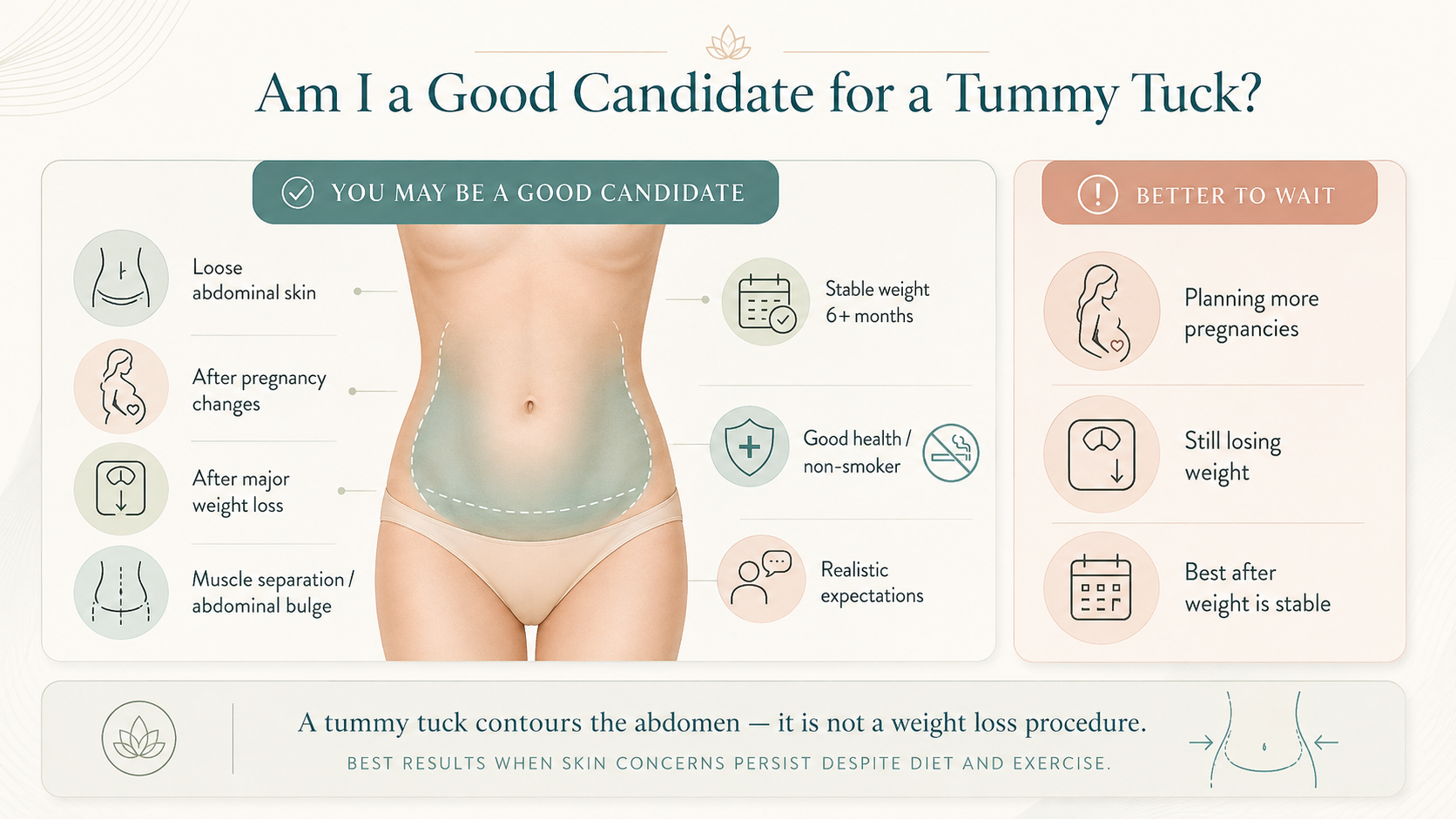
Tummy tuck surgery is most likely to be appropriate for you if one or more of the following applies:
You have loose, excess skin on the lower or full abdomen that has not responded to diet and exercise
You have had one or more pregnancies and are left with stretched skin or muscle separation that persists after recovery
You have lost a significant amount of weight and are left with excess skin around the abdomen
You have weakened or separated abdominal muscles (diastasis recti) that cause a visible abdominal bulge
You are at or close to your goal weight and have maintained a stable weight for at least six months
You are in good general health and a non-smoker, or are prepared to stop smoking well in advance of surgery
You have realistic expectations about the outcome and understand that a tummy tuck addresses skin and muscle rather than being a weight loss solution
There are also situations where it is advisable to wait before proceeding with abdominoplasty. If you are planning further pregnancies, it is generally recommended to wait until your family is complete, as a subsequent pregnancy will stretch the repaired muscles and skin again. Similarly, if you are planning significant further weight loss, it is worth reaching a stable weight first to ensure the results of surgery are as long lasting as possible.
What Happens During the Procedure?
Tummy tuck surgery is performed under general anaesthetic. Depending on the extent of the procedure, it typically takes between two and four hours.
For a full abdominoplasty, Mr Chin makes a carefully planned horizontal incision low on the abdomen, positioned to sit within or just above the natural bikini line so that it is concealed by clothing. A second incision is made around the navel. The skin is lifted from the abdominal wall to expose the underlying muscles, which are then tightened and sutured into a firmer position. Excess skin is removed, the remaining skin is redraped smoothly over the contoured abdomen, and the navel is repositioned through a small opening in the new skin layer before the incisions are closed.
The incision placement and technique are planned carefully during the consultation to achieve the best possible cosmetic result while keeping any scarring as discreet as possible.
What Does Recovery Involve?
The first two weeks
Most patients stay overnight in the hospital following tummy tuck surgery. Drains are typically placed at the time of surgery to prevent fluid accumulation, and these are removed within the first week or so once drainage has reduced to an acceptable level.
Swelling, bruising, and a degree of tightness across the abdomen are normal and expected in the initial post-operative period. A compression garment is worn to support healing and minimise swelling, and most patients find this comfortable and helpful. You will be advised to walk in a slightly stooped position for the first week or two as the skin and muscles adjust, gradually straightening as healing progresses.
Most patients are able to manage light daily activities such as short walks within a week, though someone will need to be available to help you at home for the first few days.
Returning to normal activities
Light desk-based work can typically be resumed within two to three weeks. More physically demanding work or activities that involve lifting, bending, or significant exertion should be avoided for six weeks. Exercise can be reintroduced gradually after six weeks, starting with gentle walking before progressing to more demanding activity as comfort allows.
Driving is not advisable until you are able to perform an emergency stop comfortably without hesitation, which is typically around four to six weeks after surgery.
Final results and scarring
The full result of tummy tuck surgery becomes visible once all swelling has resolved, which can take three to six months. The scar will initially appear pink and raised before gradually softening and fading over the following twelve to eighteen months. In most patients, the scar sits low enough to be easily concealed by underwear and swimwear.
Results from abdominoplasty are long lasting provided weight is maintained. The tightened muscles and reshaped skin contour are durable, and many patients enjoy their results for well over a decade.
Can a Tummy Tuck Be Combined With Other Procedures?
Abdominoplasty is frequently performed alongside other procedures for patients who want to address more than one area in a single session. Liposuction of the flanks and waist is one of the most common additions, as it allows the full midsection to be reshaped rather than just the frontal abdomen.
For women who have completed their families and want to address the full range of physical changes that can follow pregnancy, a combination of abdominoplasty with breast surgery is sometimes appropriate. This is sometimes referred to as a mummy makeover, though Mr Chin will always assess each procedure on its individual merits and will only recommend combining procedures where it is genuinely in the patient's best interest.
Where Does Mr Chin Perform Tummy Tuck Surgery?
Mr Kuen Yeow Chin performs tummy tuck surgery at a number of accredited private hospitals including Spire Thames Valley in Slough, Parkside Suites in Surrey and Ascot, and Heatherwood Hospital in Ascot. Consultations are available at the Cadogan Clinic in Chelsea, St John and St Elizabeth Hospital in St John's Wood, and London Welbeck Hospital.
To arrange a consultation, please visit the contact page or get in touch directly. No GP referral is required to book a private consultation.
-
Discomfort in the first few days after surgery is managed with prescribed pain relief. Most patients describe the sensation as tightness and pressure across the abdomen rather than sharp pain. This typically settles significantly within the first two weeks.
-
Yes. A tummy tuck involves a permanent scar, though its length and position are planned carefully to keep it as discreet as possible. In most cases the scar sits low enough to be hidden by underwear and swimwear. It will fade and flatten considerably over twelve to eighteen months.
-
It is advisable to reach a stable weight before undergoing abdominoplasty. Significant weight loss after surgery can affect the results and may require revision. Mr Chin will discuss this with you at your consultation.
-
It is generally recommended to wait until your family is complete before having a tummy tuck. A subsequent pregnancy will stretch the repaired muscles and skin, which can compromise the result.
-
Results are long lasting provided weight is maintained at a stable level. The tightened muscles and reshaped skin contour are durable, and most patients enjoy their results for many years.
-
No. You are welcome to self-refer and book a private consultation directly.
Book a Consultation With Mr Kuen Yeow Chin
If you are considering eyelid surgery and would like to discuss whether blepharoplasty is the right option for you, get in touch to arrange a consultation. Mr Chin sees patients in London and Berkshire and brings the same standard of care to every patient, whether the procedure is straightforward or complex.
You may also find it helpful to read more about all facial surgery procedures available with Mr Chin, or to visit the about page to learn more about his background, training, and clinical experience.