What to Expect From Eyelid Surgery (Blepharoplasty): A Plastic Surgeon's Guide
Written by Mr Kuen Yeow Chin, Consultant Plastic Surgeon, London and Berkshire
The eyes are often the first area of the face to show visible signs of ageing. Drooping upper eyelids, hooded skin that folds over the natural eyelid crease, and puffiness beneath the eyes can all make a person look tired, older, or less alert than they actually feel. For many people, these changes begin in their forties or fifties, though they can appear earlier depending on genetics and lifestyle.
Blepharoplasty, commonly known as eyelid surgery, is one of the most consistently performed procedures in plastic surgery for good reason. When carried out by an experienced consultant plastic surgeon, the results are subtle, natural, and long lasting. This guide covers everything you need to know about the procedure, from who it is suitable for to what recovery looks like and what results to expect. If you would like to discuss eyelid surgery with Mr Chin, consultations are available in London and Berkshire.
What Is Blepharoplasty?
Blepharoplasty is a surgical procedure that removes or repositions excess skin, muscle, and fat from the upper eyelids, lower eyelids, or both. The goal is to restore a refreshed, natural appearance to the eye area without altering the fundamental character of your face.
Upper blepharoplasty addresses drooping or hooded upper eyelids caused by excess skin accumulating above the natural eyelid crease. This can be both a cosmetic concern and, in more pronounced cases, a functional issue where the excess skin begins to interfere with the upper visual field.
Lower blepharoplasty targets puffiness, bags, and loose skin beneath the eyes. This area is particularly prone to showing fatigue and age, and is often the source of the hollowed or shadowed appearance that makes people look permanently tired regardless of how well rested they actually are.
Both procedures can be performed together for comprehensive rejuvenation of the eye area, or separately depending on where the concern lies.
Am I a Good Candidate for Eyelid Surgery?
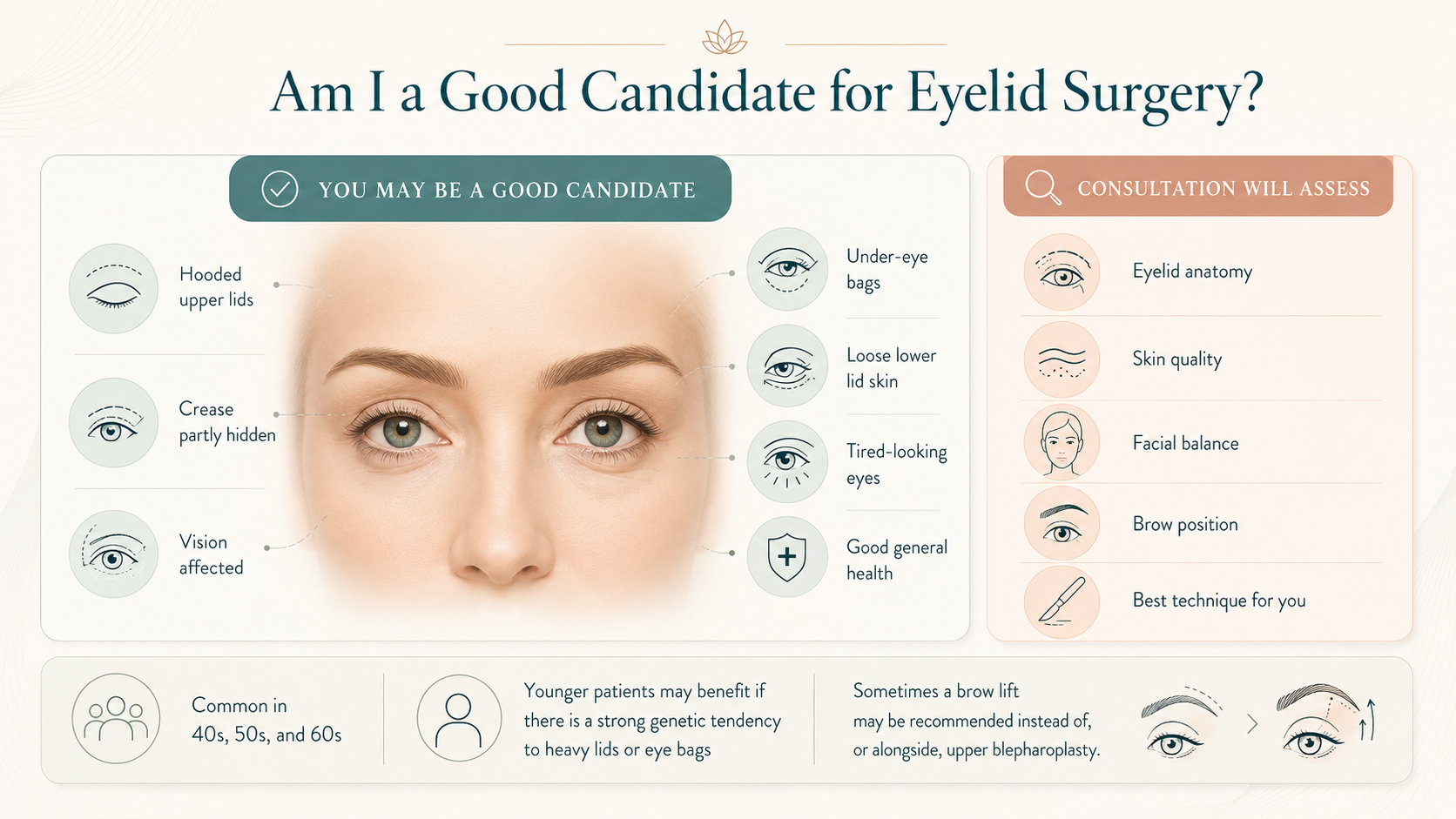
Blepharoplasty is suitable for both men and women in good general health who are bothered by one or more of the following:
Excess or drooping skin on the upper eyelids that creates a heavy, hooded appearance
Skin that folds over the natural eyelid crease, partially obscuring it
Upper eyelid skin that is beginning to affect peripheral vision
Persistent puffiness or bags beneath the eyes that do not resolve with rest
Loose, crepey skin on the lower eyelids
A consistently tired or aged appearance around the eyes that does not reflect how you feel
Most patients who come for a blepharoplasty consultation are in their forties, fifties, or sixties, though the procedure is performed on younger patients where there is a strong genetic predisposition to heavy eyelids or prominent under-eye bags.
A thorough consultation with Mr Chin will assess your eyelid anatomy, skin quality, and overall facial balance to determine whether blepharoplasty is the right approach and which technique will deliver the best result for you specifically. In some cases, a brow lift may be recommended alongside or instead of upper blepharoplasty, as brow descent can contribute to the appearance of heavy upper eyelids.
What Happens During the Procedure?
Upper blepharoplasty
The incision for upper blepharoplasty is placed within the natural crease of the upper eyelid, which means any resulting scar sits in a position that is largely invisible when the eye is open and blends naturally into the eyelid fold when closed. Through this incision, excess skin and, where needed, a small amount of fat is carefully removed. The wound is then closed with fine sutures.
Upper blepharoplasty is typically performed under local anaesthetic with sedation, meaning you are relaxed and comfortable throughout but not under general anaesthesia. The procedure itself usually takes around 45 minutes to one hour.
Lower blepharoplasty
Lower blepharoplasty can be performed using two different approaches depending on the nature of the concern. Where excess skin is the primary issue, an incision is made just below the lower lash line. Where the main concern is fat repositioning or removal without significant skin excess, a transconjunctival approach can be used, where the incision is placed on the inside of the lower eyelid and leaves no visible external scar.
Lower blepharoplasty is generally performed under local anaesthetic with sedation or, for more complex cases, under general anaesthetic. The procedure typically takes between one and two hours depending on which technique is used and whether upper and lower blepharoplasty are being combined.
Combined upper and lower blepharoplasty
When both upper and lower blepharoplasty are performed in the same session, the total operating time is typically two to three hours. Many patients choose this approach to address both areas in a single recovery period rather than returning for a second procedure at a later date.
What Does Recovery Look Like?
Recovery from blepharoplasty is manageable for most patients, though it is important to go in with realistic expectations about the initial post-operative period.
The first week
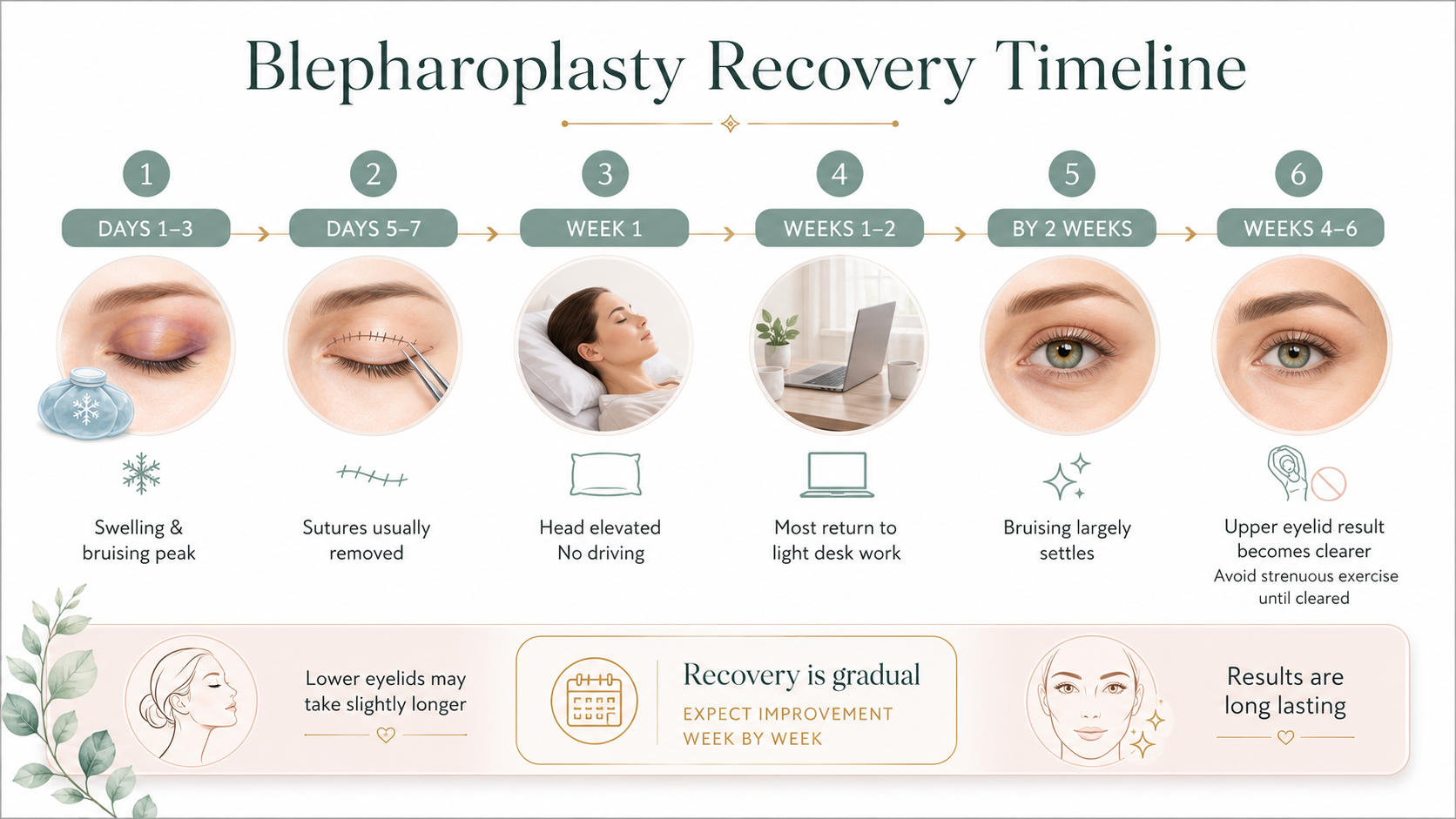
Swelling and bruising around the eyes is normal and expected in the days immediately after surgery. Cold compresses can help manage this in the early stages. Most patients find the bruising and swelling most pronounced on days two and three, after which it gradually subsides. Fine sutures are typically removed around five to seven days after the procedure.
You will be advised to sleep on your back with your head slightly elevated for the first week to ten days to minimise swelling. Driving is not possible in the immediate post-operative period, so arranging someone to take you home after surgery and to help you for the first day or two is advisable.
Returning to normal activities
Most patients feel comfortable returning to light desk-based work within one to two weeks. Strenuous exercise, heavy lifting, and activities that increase blood pressure to the head should be avoided for four to six weeks. Reading and screen time may feel uncomfortable in the first few days as the eyes can feel dry or sensitive, and lubricating eye drops are often recommended during the recovery period.
Most of the visible bruising will have resolved by two weeks, at which point most patients feel confident going out in public. Any residual swelling, which is generally subtle rather than obvious, continues to settle over the following weeks.
Final results
The full result of blepharoplasty becomes visible once all swelling has completely resolved, which typically takes four to six weeks for upper blepharoplasty and slightly longer for lower blepharoplasty. The outcome is a refreshed, natural appearance around the eyes that does not look operated on. The aim is always for people to notice that you look well rested and revitalised, not that you have had surgery.
Results from blepharoplasty are long lasting. Upper eyelid surgery typically produces results that last ten years or more. Lower blepharoplasty results tend to be similarly durable, though the natural ageing process continues over time.
Can Blepharoplasty Be Combined With Other Procedures?
Blepharoplasty is frequently performed alongside other facial rejuvenation procedures for patients who want to address more than one area in a single session. Facelift surgery and brow lifting are the most common combinations, as they address the midface, lower face, and brow position while blepharoplasty focuses on the eyelids. Combining procedures in this way means a single recovery period and a more comprehensive, harmonious result.
Whether combination surgery is appropriate depends on your overall health, the extent of the procedures being considered, and your personal priorities. Mr Chin will discuss this with you in detail at your consultation and will only recommend combining procedures where he believes it is in your best interest to do so.
Where Are Consultations and Surgery Available?
Mr Kuen Yeow Chin sees patients for private consultations at the Cadogan Clinic in Chelsea, London, St John and St Elizabeth Hospital in St John's Wood, London, and the London Welbeck Hospital. Surgery is carried out at a number of accredited private hospitals including Spire Thames Valley, Parkside Suites in Surrey and Ascot, and Heatherwood Hospital in Ascot.
To arrange a consultation to discuss eyelid surgery or any other procedure, please visit the contact page or get in touch directly. Mr Chin's team will be happy to help you find a convenient appointment time.
-
Discomfort during the procedure is minimised by local anaesthetic. Post-operatively, most patients describe the sensation as tightness and sensitivity around the eyes rather than significant pain. Mild pain relief is usually sufficient in the days following surgery.
-
Incisions are placed in natural creases and folds where any resulting scars blend into the surrounding skin. Upper eyelid scars are typically invisible when the eye is open. Lower eyelid scars, where an external incision is used, are placed just below the lash line and fade significantly over time. The transconjunctival approach for lower blepharoplasty leaves no external scar at all.
-
Upper blepharoplasty results typically last ten years or more. Lower blepharoplasty results are similarly long lasting, though the ageing process naturally continues over time. Many patients are satisfied with their results for well over a decade before considering any further treatment.
-
In cases where excess upper eyelid skin is drooping into the visual field, upper blepharoplasty can meaningfully improve peripheral vision. This is assessed as part of the consultation process.
-
No. You are welcome to self-refer and book a private consultation directly without a GP letter.
-
Yes. Eyelid surgery is performed on both men and women. The approach is tailored to preserve natural masculine features while achieving a refreshed, less tired appearance.
Book a Consultation With Mr Kuen Yeow Chin
If you are considering eyelid surgery and would like to discuss whether blepharoplasty is the right option for you, get in touch to arrange a consultation. Mr Chin sees patients in London and Berkshire and brings the same standard of care to every patient, whether the procedure is straightforward or complex.
You may also find it helpful to read more about all facial surgery procedures available with Mr Chin, or to visit the about page to learn more about his background, training, and clinical experience.