
When Should You Get a Mole Checked? A Plastic Surgeon's Guide
Most of us have somewhere between 10 and 40 moles, and the overwhelming majority will never cause a problem. But knowing when to get a mole checked is one of the simplest and most valuable things you can do for your long-term health, because melanoma - the most serious form of skin cancer - is highly treatable when it is caught early, and considerably harder to treat when it is not.
Around 19,400 people are diagnosed with melanoma in the UK each year, roughly 53 every day, and incidence has risen by more than 160% since the early 1990s. The encouraging side of that picture is that more than nine in ten people diagnosed survive for ten years or longer, and an estimated 86% of cases are considered preventable.
This guide explains what to look for on your own skin, which changes warrant a professional opinion, and what actually happens when you see a skin cancer specialist.
Most moles are entirely normal
Moles, or naevi, are clusters of pigment-producing cells. They typically appear during childhood and adolescence, and it is perfectly normal to develop new ones into your twenties and thirties. A healthy mole is usually round or oval, one consistent shade of brown or tan, smaller than a pencil eraser, and - crucially - stable. It looks the same this year as it did last year.
The problem is that "stable" is difficult to judge from memory. Very few people could accurately describe a mole on their own back from six months ago. That is why a structured approach matters more than a general sense that something looks a bit different.
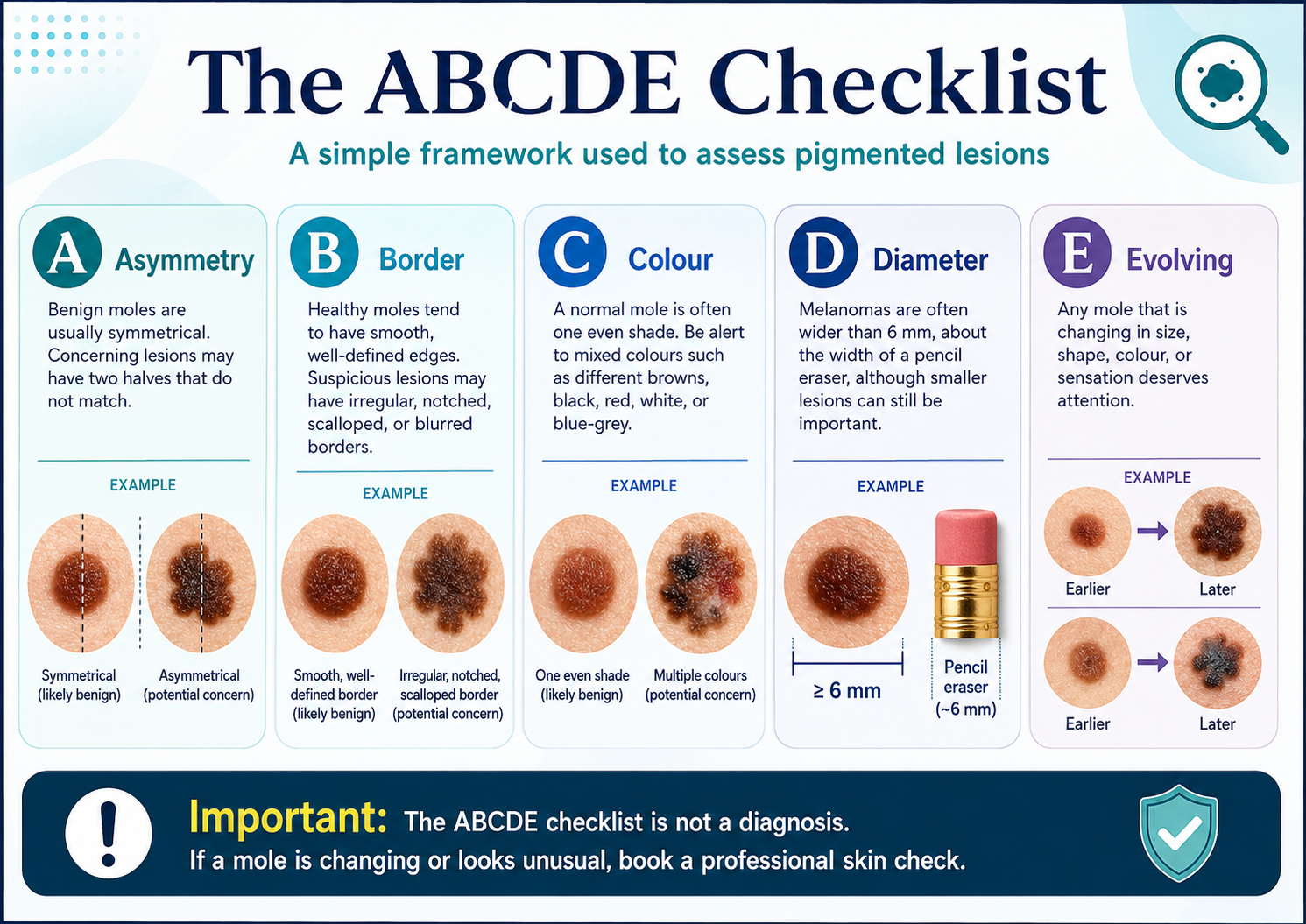
The ABCDE checklist
Dermatologists and plastic surgeons use a simple five-point framework to assess pigmented lesions. It is not a diagnosis, but it is an excellent filter for deciding whether something needs a professional eye.
A - Asymmetry. Imagine a line drawn through the middle of the mole. In a benign mole, the two halves broadly match. In a melanoma, they often do not.
B - Border. Healthy moles have smooth, well-defined edges. Suspicious lesions tend to have irregular, notched, scalloped or blurred borders that fade into the surrounding skin.
C - Colour. A normal mole is usually a single uniform shade. Be alert to a mixture of two or more colours in one lesion - different browns, black, red, white, or blue-grey patches.
D - Diameter. Melanomas are frequently wider than 6mm, about the width of a pencil eraser. This is a useful guide rather than a rule; melanomas can and do present when they are smaller.
E - Evolving. This is the single most important letter. Any mole that is changing in size, shape, colour, or sensation deserves attention, even if it fails every other criterion.
The "ugly duckling" sign
Alongside ABCDE, there is a second technique that is often more intuitive. Most people's moles look broadly like siblings - similar size, similar colour, similar character. The ugly duckling sign is the lesion that clearly does not belong to the family. If one mole stands out from the crowd on your body, it is worth having it assessed, even if it does not tick a specific ABCDE box.
Warning signs that have nothing to do with shape
Not every concerning skin change is about outline or colour. The NHS advises seeing a doctor about a mole that has become painful or itchy, one that is inflamed, bleeding or crusty, or a new mark on the skin that has not resolved after a few weeks.
One sign that is frequently overlooked is a dark streak or area underneath a fingernail or toenail that is not the result of an obvious injury. Subungual melanoma is rare, but it is easily dismissed as a bruise, and lesions in this area often require the combined skin and hand surgery expertise that not every clinician can offer.
Who is at higher risk?
Anyone can develop skin cancer, but some people should have a lower threshold for getting checked. Risk is higher if you have fair skin that burns easily, red or blonde hair, a large number of moles (more than 50), a history of severe or blistering sunburn - particularly in childhood - a personal or family history of skin cancer, significant sunbed use, or a weakened immune system, including after an organ transplant.
If two or more of those apply to you, an annual professional skin check is a sensible baseline rather than an over-reaction.
What actually happens at a mole check
A specialist consultation is more straightforward than most people expect and is not painful.
Your surgeon will take a history covering sun exposure, family history and how the lesion has behaved over time. They will then examine the lesion using a dermatoscope - a handheld magnifier with polarised light that reveals pigment patterns and vascular structures invisible to the naked eye. In most cases they will examine your skin more broadly, since people who present with one concerning lesion sometimes have another they had not noticed.
You will usually leave with one of three outcomes: clear reassurance, a plan to photograph and monitor the lesion over a defined interval, or a recommendation to remove it for laboratory analysis.
Mole mapping: who it's genuinely for
Mole mapping is a non-invasive, full-body imaging process that photographs and documents your moles so that any future change can be measured objectively rather than guessed at. At Mr Chin's practice it is offered from £380 at the Apex Clinic, Berkshire Grove Hospital.
It is not necessary for everyone. It is most valuable for people with a high mole count, atypical or dysplastic moles, a personal or family history of melanoma, or anyone who has already had a lesion removed and wants systematic surveillance rather than annual guesswork.
Having a mole removed
If removal is recommended, the procedure is typically done under local anaesthetic as a day case and takes under an hour. The lesion is excised with a margin of surrounding tissue, the wound is closed with sutures, and the specimen is sent for histopathology. Results usually take one to two weeks.
Two points are worth understanding before you book anywhere.
First, every removed lesion should be sent for pathology. A mole removed purely for cosmetic reasons by a practitioner who does not send tissue for analysis represents a genuine missed opportunity, because the one thing you cannot recover afterwards is the diagnosis.
Second, who performs the excision affects both the oncological result and the cosmetic one. Achieving a clear margin while minimising the final scar is a surgical skill, and it matters most on the face, where reconstruction may involve a local flap or graft. Mr Chin's background in facial surgery and reconstruction is directly relevant here, and scar revision is available if an older scar has healed poorly.
At this practice, benign lesion excision starts from £1,200, skin cancer treatment from £1,000, cryotherapy for superficial lesions from £500, and sentinel lymph node biopsy from £3,500.
NHS or private?
Both routes are legitimate and they are not mutually exclusive.
If you have a lesion that concerns you, see your GP. If they share your concern, you should be referred on an urgent suspected cancer pathway, usually to be seen within two weeks. That pathway works, it is free, and you should absolutely use it.
People generally choose to go privately for different reasons: they want to be seen in days rather than weeks for peace of mind, they want continuity with one named consultant from diagnosis through surgery and follow-up, they want mole mapping and structured surveillance that is not routinely available on the NHS, or they have private medical insurance that covers investigation of a suspicious lesion.
What you should not do is wait. Delay is the only variable in this entire process that is completely within your control.
-
A private consultation with dermoscopy typically ranges from about £150 to £350 nationally. Full-body mole mapping is a separate service, offered at Mr Chin's practice from £380. Excision of a benign lesion starts from £1,200.
-
Yes. Cosmetic removal of a benign mole is a common and reasonable request. It should still be assessed by a clinician first and the tissue sent for pathology, and you should discuss the likely scar beforehand - you are exchanging a mole for a small line, and on some sites that trade is more favourable than others.
-
Yes, any excision leaves a scar. The realistic goal is a fine, flat, pale line that fades over 12 to 18 months. Technique, site and your own healing all influence the outcome, which is why surgical experience matters more than people assume for what looks like a minor procedure.
-
Roughly once a month is a sensible rhythm. Use a mirror for your back, and ask a partner to check your scalp and the backs of your legs. Photographing anything you are unsure about gives you an objective comparison next month.
-
No. Dermoscopy is entirely non-contact or light-contact and painless. If a lesion is removed, the area is numbed with local anaesthetic; you may feel a brief sting as it is administered and pressure afterwards, but not pain.
-
Yes, and this is a common misconception. Pooled research findings suggest around 71% of melanomas arise on previously normal-looking skin, and only about 29% develop within an existing mole. Any new, persistent, changing mark deserves the same attention as a changing mole.
-
New moles into your thirties are usually normal. A genuinely new pigmented lesion appearing after about 40 is worth having assessed, simply because the baseline probability shifts with age.
-
Usually one to two weeks. If your lesion is being treated as urgent, results are typically expedited, and your consultant should tell you at the time of surgery when and how you will receive them.
Getting checked
Skin cancer is one of the few cancers you can genuinely see. That makes early detection far more achievable than for most other diagnoses - but only if someone looks.
Mr Kuen Yeow Chin is a Consultant Plastic Surgeon with over 19 years of experience, Clinical Lead for Plastic Surgery at Frimley Health NHS Foundation Trust and Skin Cancer Lead at Frimley Park Hospital. He is a member of BAPRAS, BAAPS and Melanoma Focus, and holds clinics across London, Berkshire and Surrey.
If you have a mole that has changed, a mark that will not heal, or you simply want the reassurance of a professional opinion, book a consultation or explore the full range of procedures available.
This article is intended for general information and does not replace individual medical advice. If you are concerned about a mole or skin lesion, please see your GP or a qualified specialist promptly.